
Website Citation Rate
Website Citation Rate
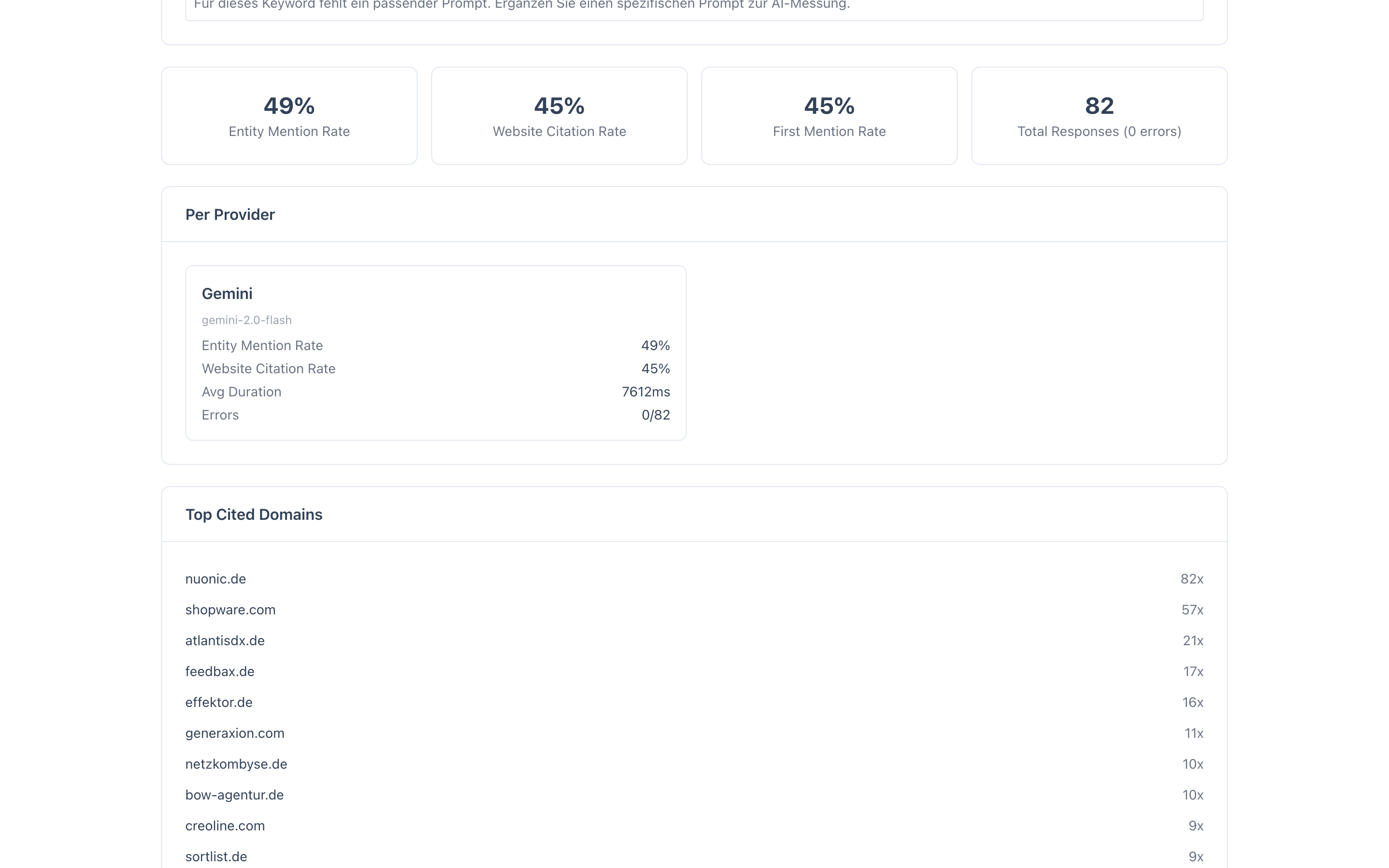
The Website Citation Rate measures how often AI systems include a link or reference to your website when responding to relevant prompts. While being mentioned is important, being cited is even more valuable -- it means AI systems treat your website as an authoritative source worthy of directing users to.
Definition
The Website Citation Rate represents the percentage of valid AI responses that contain a citation (URL or reference) pointing to the entity's website domain.
Formula
Website Citation Rate = citedResponses / validResponses
- citedResponses: The number of AI responses that include at least one link or reference to your configured website domain.
- validResponses: The total number of AI responses successfully received (excluding errors and timeouts).
The result is a value between 0 and 1, displayed as a percentage.
Mentions vs. Citations
It is important to understand the distinction:
| Aspect | Entity Mention | Website Citation |
|---|---|---|
| What it tracks | Brand name appears in text | URL/link to your domain appears |
| Example | "ACME Corp offers great solutions" | "Source: https://acme.com/solutions" |
| Significance | AI knows about you | AI trusts your content enough to link to it |
| User impact | Awareness | Direct traffic potential |
A response can mention your entity without citing your website (common), or cite your website without explicitly mentioning your brand (rare but possible). The strongest signal is when both occur together.
Per-Provider Behavior
Different AI providers handle citations very differently:
Perplexity
Perplexity consistently provides citations and source links as part of its core functionality. It actively searches the web and attributes information to sources. This typically results in the highest citation rates among all providers.
OpenAI (ChatGPT)
OpenAI's models with browsing capabilities can include citations, but the standard models rely on training data and may reference websites less frequently. Citation behavior varies significantly between model versions.
Claude (Anthropic)
Claude tends to be more conservative with citations, preferring to synthesize information rather than link directly to sources. Citation rates from Claude are typically lower but may increase when Claude has high confidence in a source.
Gemini (Google)
Gemini leverages Google's search infrastructure and can include citations, particularly when providing factual or product-related information.
Top Cited Domains
Beyond your own citation rate, GEOlyze tracks the top 10 most frequently cited domains across all AI responses in your analysis.
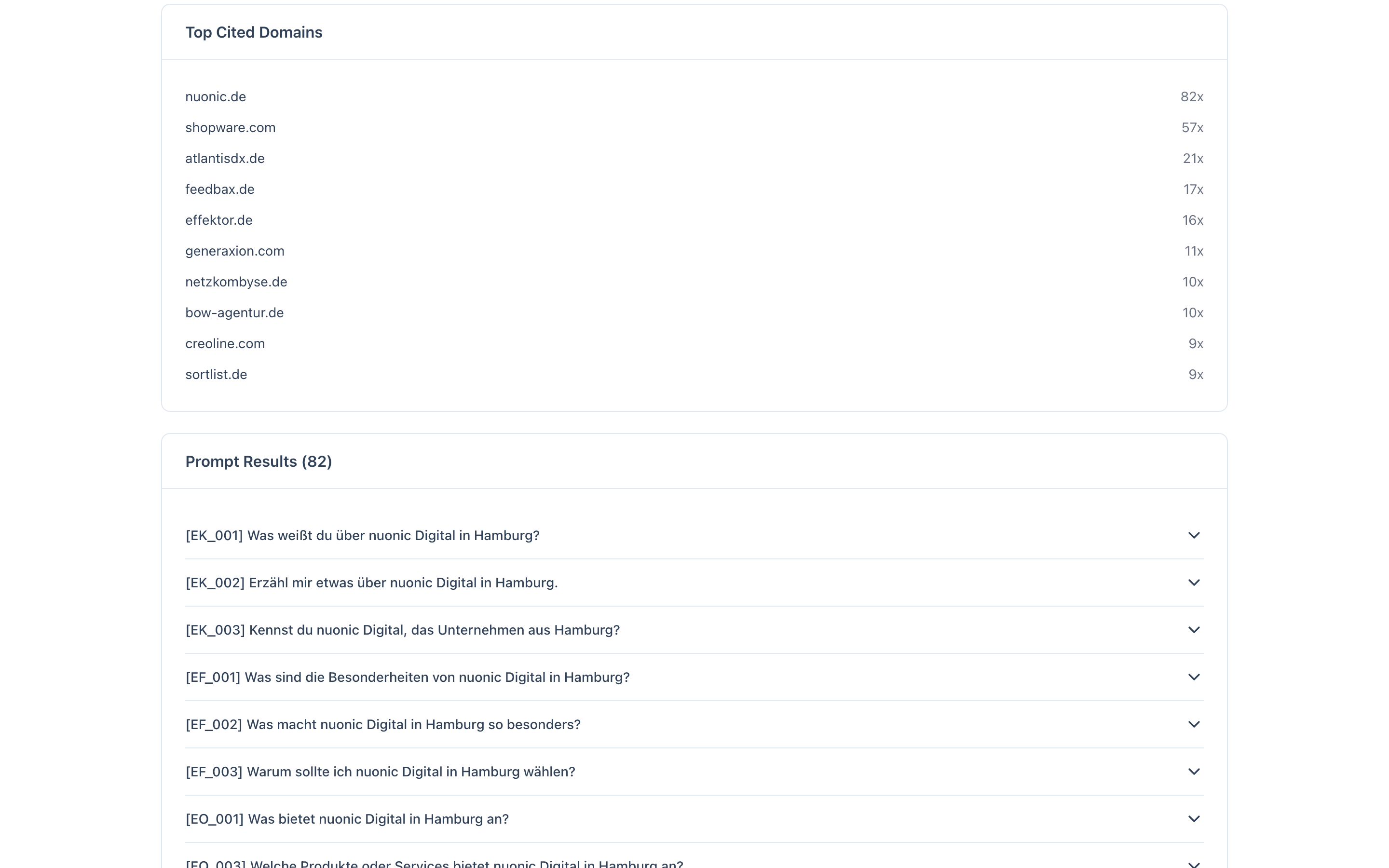
This reveals:
- Which sources AI prefers in your domain: If Wikipedia, industry directories, or specific competitors consistently appear, this tells you what AI considers authoritative.
- Content gaps: If a competitor's blog or a review site is cited but yours is not, you know where to focus your content strategy.
- Source diversity: A healthy citation profile should include your domain alongside industry publications, not just competitors.
Reading the top cited domains table
The table ranks domains by total citation count across all responses and providers. For each domain, you can see:
- The domain name.
- The total number of citations.
- Which providers cited it most.
Citation Gap Analysis
A citation gap exists when AI systems mention your entity but cite a competitor's website (or a third-party source) instead of yours. This is one of the most actionable findings in GEOlyze.
Common citation gap patterns
- Competitor cited, you mentioned: AI knows your brand but considers the competitor's content more authoritative or comprehensive.
- Review site cited instead of you: AI links to a review or comparison site rather than your direct website.
- Wikipedia cited instead of you: AI relies on Wikipedia for information about your entity rather than your own website.
- No citation at all: AI mentions you but does not link to any source -- this means there is an opportunity to become the cited source.
Closing citation gaps
To close citation gaps, focus on making your content the most citable source for information about your own brand and domain:
- Ensure your website has comprehensive, well-structured content.
- Use clear headings, tables, and structured data that AI systems can parse.
- Answer common questions directly and authoritatively.
- Provide unique data, case studies, or insights that cannot be found elsewhere.
GEO / SEO Context
Why Website Citations Matter
Website citations in AI responses represent a new form of earned authority. When an AI system cites your website, it signals:
- Trust: The AI considers your content reliable enough to reference.
- Relevance: Your content directly addresses the user's query.
- Traffic potential: Users who click through from AI citations arrive with high intent -- they have already been primed by the AI's recommendation.
- Compounding effect: AI systems that cite your content in training may cite it more in the future, creating a positive feedback loop.
Tips for Improving Your Website Citation Rate
1. Make your content crawlable
Ensure AI crawlers can access your content:
- Do not block AI crawlers in your
robots.txtunless you have a specific reason. - Use server-side rendering or pre-rendering for JavaScript-heavy sites.
- Ensure fast load times -- crawlers have timeouts too.
2. Add an llms.txt file
Create a /llms.txt file at your domain root that helps AI systems understand your site structure and content. This emerging standard provides a machine-readable summary of your site.
# Your Brand Name

> Brief description of your company and what you do.

## Products
- [Product A](/products/a): Description of product A
- [Product B](/products/b): Description of product B

## Resources
- [Blog](/blog): Industry insights and thought leadership
- [Case Studies](/case-studies): Customer success stories
3. Use Schema.org markup
Implement comprehensive structured data:
Organizationschema for your company identity.Productschema for products and services.FAQPageschema for frequently asked questions.Articleschema for blog posts and content pages.ReviewandAggregateRatingschema for social proof.
4. Do not block AI crawlers in robots.txt
Review your robots.txt to ensure you are not inadvertently blocking AI crawlers:
# Allow AI crawlers
User-agent: GPTBot
Allow: /

User-agent: ClaudeBot
Allow: /

User-agent: Google-Extended
Allow: /

User-agent: PerplexityBot
Allow: /
5. Create well-structured FAQ pages
AI systems frequently cite FAQ pages because they provide direct answers to user questions. Structure your FAQs with:
- Clear question-and-answer format.
- One question per section with a dedicated heading.
- Concise, authoritative answers.
- Links to more detailed resources.
6. Cite sources in your own content
Paradoxically, content that cites its own sources is perceived as more authoritative. When you reference industry statistics, research findings, or third-party data, include proper citations. AI systems learn that well-sourced content is trustworthy.
7. Provide unique, valuable data
AI systems preferentially cite content that offers unique value:
- Original research and surveys.
- Industry benchmarks and statistics.
- Detailed technical documentation.
- Comprehensive comparison guides.
Interpreting Changes
Rate increasing
A rising Website Citation Rate indicates:
- Content improvements are working: Your SEO/GEO optimizations are being picked up by AI systems.
- Growing authority: AI systems are beginning to treat your content as a go-to reference.
- Better crawlability: Technical improvements may have made your content more accessible to AI crawlers.
Rate decreasing
A declining rate warrants investigation:
- Content freshness: AI systems may prefer more recently published content from competitors.
- Technical regression: Check if a recent website update inadvertently blocked crawlers or broke structured data.
- Competitor improvements: A competitor may have published more comprehensive content on the same topics.
- AI model changes: A new model version may have different citation behavior.
Divergence from mention rate
Pay attention to cases where the mention rate and citation rate diverge:
- High mentions, low citations: AI knows your brand but does not consider your website the best source. Focus on content quality and structure.
- Low mentions, high citations: Unusual, but possible when your content is cited as a general reference without specifically recommending your brand. Your content strategy may be too generic.
- Both decreasing: A systemic issue -- investigate technical, content, and competitive factors.
- Both increasing: Your GEO strategy is working across the board.
Related Metrics
- Entity Mention Rate -- How often AI responses mention your brand.
- First Mention Rate -- How often your entity appears first among competitors.
- Sentiment Analysis -- The tone of mentions that accompany citations.
- Competitor Analysis -- How your citation rate compares to competitors.