

Entity Mention Rate
Entity Mention Rate
The Entity Mention Rate is the most fundamental visibility metric in GEOlyze. It measures how often AI systems mention your company, brand, or entity when responding to relevant prompts. In the context of Generative Engine Optimization (GEO), this metric is the equivalent of ranking in traditional search -- if an AI does not mention your brand, you are invisible to its users.
Definition
The Entity Mention Rate represents the percentage of valid AI responses that contain a mention of your entity (company name, brand name, or configured entity identifier).

Formula
Entity Mention Rate = mentionedResponses / validResponses
- mentionedResponses: The number of AI responses that contain at least one validated mention of your entity.
- validResponses: The total number of AI responses that were successfully received (excluding errors, timeouts, and invalid responses).
The result is a value between 0 and 1, displayed as a percentage (e.g., 0.65 = 65%).
What counts as a valid response?
A response is considered valid when the AI provider returned a complete answer without errors. Responses that timed out, returned HTTP errors, or were flagged as malformed are excluded from both the numerator and denominator. This ensures the metric reflects genuine AI behavior rather than infrastructure issues.
Per-Provider Breakdown
GEOlyze queries multiple AI providers for each prompt, and the Entity Mention Rate is tracked individually for each one:
| Provider | Description |
|---|---|
| Claude (Anthropic) | Anthropic's Claude model family |
| OpenAI (GPT) | OpenAI's GPT model family |
| Gemini (Google) | Google's Gemini model family |
| Perplexity | Perplexity AI's answer engine |
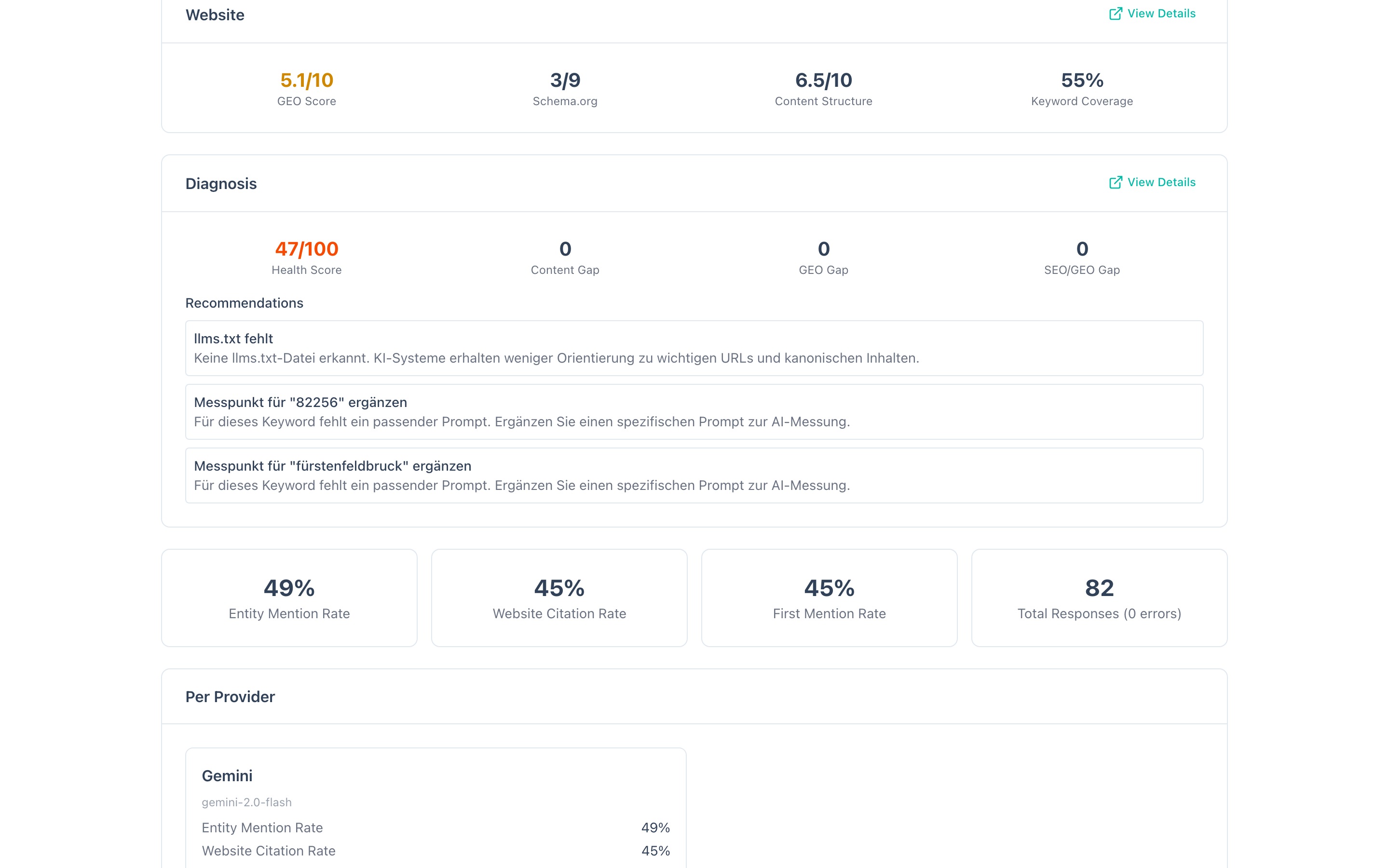
Each provider may have significantly different mention rates for the same entity. This is expected -- different AI systems are trained on different data, have different knowledge cutoffs, and use different retrieval mechanisms. Understanding these differences helps you prioritize which AI ecosystems to target with your GEO strategy.
Why providers differ
- Training data composition: Each model is trained on a different corpus, so one provider may have encountered your brand more frequently.
- Knowledge cutoff dates: Newer models may reflect more recent content about your entity.
- Retrieval-augmented generation (RAG): Providers like Perplexity actively search the web, making them more responsive to current content changes.
- Response style: Some models tend to give more specific recommendations, while others stay general.
Sub-Metrics
Entity in First Sentence (First Mention Rate)
This sub-metric tracks whether your entity appears in the opening statement of the AI response. Being mentioned in the first sentence is significantly more impactful than being mentioned in the middle or end of a response, because:
- Users often skim only the beginning of AI responses.
- The first recommendation carries implicit priority and authority.
- AI systems that lead with your brand are effectively treating it as their top suggestion.
The first mention rate is tracked at the overall level, not per-provider. See the dedicated First Mention Rate documentation for details.
Entity Mention Count
Beyond the binary question of "was it mentioned?", GEOlyze also tracks how many times your entity name appears in each response. A response that mentions your brand five times in a detailed recommendation is a stronger signal than one that mentions it once in passing.
This count helps distinguish between:
- Passing mentions: Your entity appears once, perhaps in a list of alternatives.
- Focused recommendations: The AI dedicates significant attention to your entity, mentioning it multiple times in context.
- Detailed comparisons: Your entity is discussed alongside competitors with multiple references.
Mention Validation
Not every string match counts as a genuine mention. GEOlyze applies validation logic to filter out false positives and ensure the metric is accurate.
Validation filters
GEOlyze checks for and excludes the following patterns:
- Partial name matches: If your entity name is "Blue" and the AI mentions "Bluetooth" or "Blueprint", these are not counted.
- List items without context: Bare mentions in unrelated lists (e.g., a list of colors) are filtered.
- Negation patterns: Statements like "I would not recommend Entity" or "Unlike Entity, other options..." are identified and can be flagged separately.
- Quoted references: Mentions that appear only as part of a citation or source attribution, without the entity being recommended, are distinguished from genuine recommendations.
Case sensitivity
Entity matching is case-insensitive by default. "ACME Corp", "acme corp", and "Acme Corp" are all counted as mentions of the same entity.
GEO / SEO Context
Why Entity Mention Rate matters
In traditional SEO, success is measured by ranking position on search engine results pages (SERPs). In the age of AI-powered search, the equivalent of ranking is being mentioned. When an AI system mentions your brand in response to a relevant query, it is effectively recommending you to the user.
Key implications:
- Zero mention = zero visibility: If AI systems do not mention your brand, you do not exist in the AI search ecosystem.
- Mention rate correlates with AI-driven traffic: As more users rely on AI assistants for recommendations, your mention rate directly influences discovery and consideration.
- Competitive displacement: When AI mentions your competitors but not you, users are being actively directed away from your brand.
Tips for Improving Your Entity Mention Rate
1. Ensure consistent entity naming
Use a single, consistent brand name across your website, social media, press releases, and all online properties. AI models learn from patterns -- inconsistent naming (e.g., "ACME", "Acme Corp.", "ACME Corporation") dilutes your signal.
2. Use structured data (Organization schema)
Implement Organization schema markup on your website with:
{
  "@context": "https://schema.org",
  "@type": "Organization",
  "name": "Your Brand Name",
  "url": "https://yourbrand.com",
  "sameAs": [
    "https://linkedin.com/company/yourbrand",
    "https://twitter.com/yourbrand"
  ]
}
This helps AI systems unambiguously identify and reference your entity.
3. Provide authoritative, citable content
AI systems prefer to recommend entities they can back up with evidence. Create:
- Detailed product/service pages with clear value propositions.
- Case studies and testimonials that demonstrate real-world results.
- Comparison pages that position you against competitors (respectfully and factually).
- FAQ pages that directly answer the kinds of questions AI users ask.
4. Build topical authority
Publish in-depth content about your domain. AI models are more likely to mention brands they associate with expertise in a given area. Blog posts, whitepapers, research reports, and thought leadership content all contribute.
5. Get mentioned on third-party sources
AI systems do not only learn from your website. Being mentioned on:
- Industry review sites and directories.
- News publications and press coverage.
- Wikipedia and other knowledge bases.
- Community forums and discussion platforms.
... all increase the likelihood that AI models include your brand in their training data and retrieval results.
6. Add an llms.txt file
Provide an llms.txt file at your domain root to explicitly tell AI crawlers what your brand is about and how to reference it.
Interpreting Changes
Rate increasing
A rising Entity Mention Rate is a strong positive signal. Common causes include:
- Content improvements: You published new, authoritative content that AI systems are now referencing.
- Structured data additions: Adding Organization schema or improving existing markup.
- Third-party coverage: New press mentions, reviews, or directory listings.
- AI model updates: A provider released a new model with more recent training data that includes your brand.
Rate decreasing
A declining rate requires investigation. Consider:
- Competitor gains: A competitor may have improved their GEO strategy, displacing your mentions.
- Content staleness: If your content has not been updated recently, AI systems may start favoring more current sources.
- Technical issues: Check that AI crawlers are not blocked in your
robots.txtand that your site is accessible. - Model changes: A provider may have switched to a model with different training data.
Provider-specific changes
If one provider's rate changes significantly while others remain stable, this is usually attributable to:
- A model update or version change by that specific provider.
- Changes in that provider's retrieval or search integration.
- Your content being indexed differently by that provider's data pipeline.
Cross-reference with the Website Citation Rate -- if mentions drop but citations stay stable (or vice versa), this reveals different dynamics at play.
Related Metrics
- Website Citation Rate -- How often AI responses link to your website.
- First Mention Rate -- How often your entity appears first among competitors.
- Sentiment Analysis -- Whether mentions of your entity are positive, neutral, or negative.
- Competitor Analysis -- How your mention rate compares to competitors.